(Evolutionary) Macroecology
Macroecological patterns under an evolutionary perspective
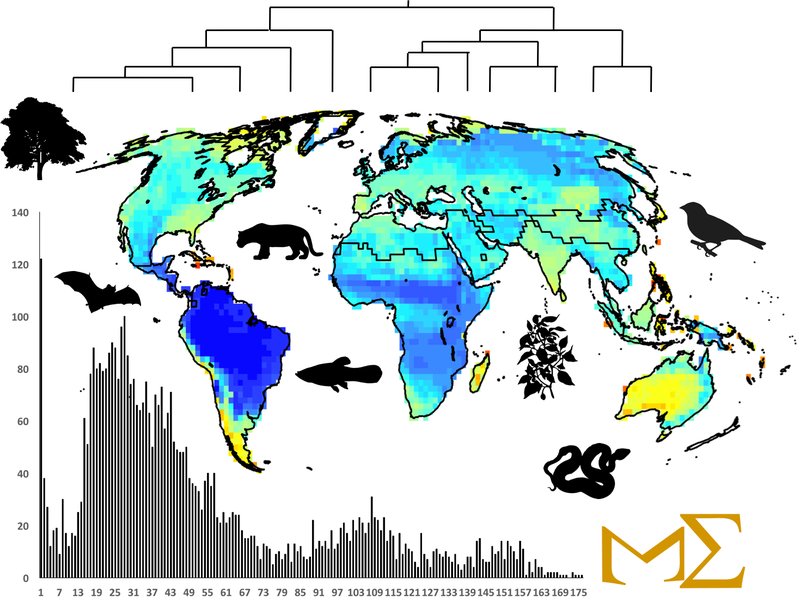
We are interested in all things “macroecological.” Macroecology is a synthetic research program that seeks to understand the emergent, statistical properties of complex ecological systems (e.g. ecological communities, complete biotas, biodiversity patterns) at broad spatial and temporal scales. We are particularly interested in macroecological research owing to its integration of ecology, biogeography and macroevolution, considering processes at different scales, in order to explain geographic biodiversity patterns.
Under this research program, we have described and evaluated species richness gradients considering the inherent relationship between diversity and distribution (Villalobos & Arita 2010; Villalobos et al. 2014) as well as the intricate relationship between ecological and evolutionary drivers of such gradients (García-Andrade et al. 2023).
We investigate “traditional” macroecological patterns such as those looking at richness differences among regions and relating them to the environment and history of such regions (e.g. Arango et al. 2021; Gouveia et al. 2014; Velasco et al. 2018), as well as the drivers that determine geographic range size variations (Carvajal-Quintero et al. 2019; López-Reyes et al. 2024; Olalla-Tárraga et al. 2019). Most macroecological research requires large amounts of data and particular tools to handle and analyze such data. In order to help in this endeavor, we continuously work in collaboration with other colleagues to develop and contribute useful tools for conducting macroecological research (e.g. the letsR package in R; Vilela & Villalobos 2015).
Currently, we include phylogenetic/macroevolutionary approaches to understand geographic gradients of biodiversity and related macroecological patterns (Villalobos et al. 2020; Rubalcaba et al. 2023; Herrera-Pérez et al. 2026). More specifically, we test evolutionary hypotheses (Alves et al. 2017) and processes driving biodiversity patterns (García-Andrade et al. 2023; García-Rodriguez et al. 2025; Pinto-Ledezma et al. 2019) as well as trait evolution such as Grinnellian niches (Peixoto et al. 2017; Esparza-Estrada et al. 2022), their physiological limits (Bennett et al. 2021; Moore et al. 2023), or other ecological traits such as diets (Ochoa-Sanz et al. 2025).
You can find a (non-systematic) review of macroecological approaches to study evolutionary diversification under a geographic perspective in Villalobos et al. 2020 (In: Rull V., Carnaval A. (eds) Neotropical Diversification: Patterns and Processes. Springer) and our approach to study the evolution and responses to climate change in Villalobos et al. 2026 (in the Encyclopedia of Evolutionary Biology, Elsevier).