Macroevolution
Macroevolutionary patterns across space and time
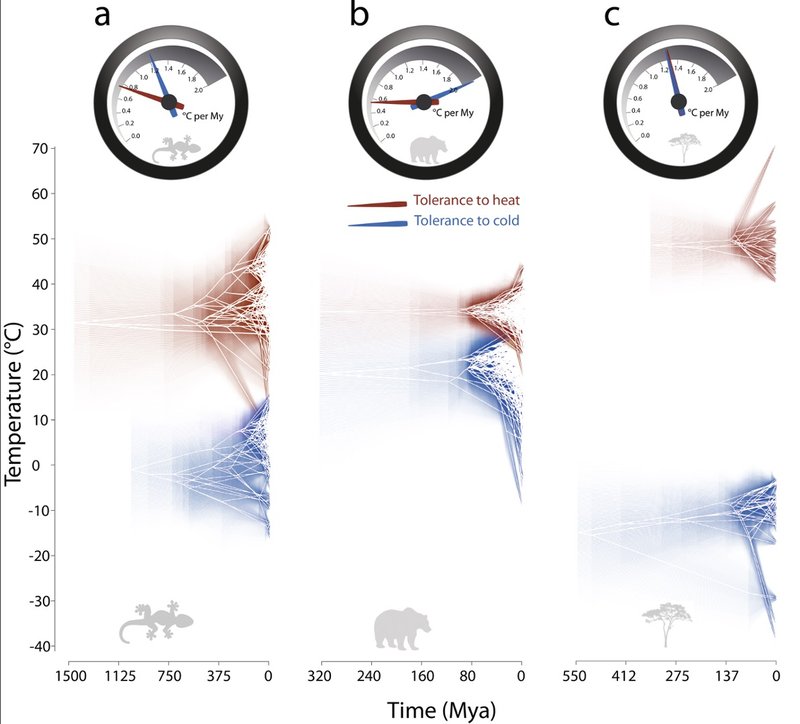
Along with the description and evaluation of geographical biodiversity patterns, our research focuses on investigating the actual processes that change species numbers within and across the planet: evolutionary processes related to speciation, extinction and biogeographic dispersal (Alves et al. 2017; Pinto-Ledezma et al. 2019; Arango et al. 2025; López-Reyes et al. 2025). In the same vein, we are interested in the (macro)evolution of species traits as related to their macroecological patterns such as body size gradients (Velasco et al. 2020; Rubalcaba et al. 2022), habitat (Rodrigues et al. 2019; Esparza-Estrada et al. 2022) or diet preferences (Ochoa-Sanz et al. 2025) and the evolutionary convergence of eco-morphs (Verde-Arregoitia et al. 2025). Evaluating such macroevolutionary processes at broad spatial scales has become commonplace in macroecology and several techniques are now applied to the study of evolutionary diversification under a geographic perspective (see a review on this topic in Villalobos et al. 2020 [In: Rull V., Carnaval A. (eds) Neotropical Diversification: Patterns and Processes. Springer]).
Given the nature of both macroecological and macroevolutionary patterns driven by species traits and their evolutionary history, we rely heavily on Phylogenetic Comparative Methods (PCMs). For this same reason, we carefully consider PCMs and other evolutionary/biogeographical methods, while also being interested in applying, testing (Alves et al. 2017; Jardim et al. 2021) and developing such methods (Diniz-Filho et al. 2015; Duarte et al. 2025) to understand the tempo and mode of macroevolutionary and macroecological patterns.